
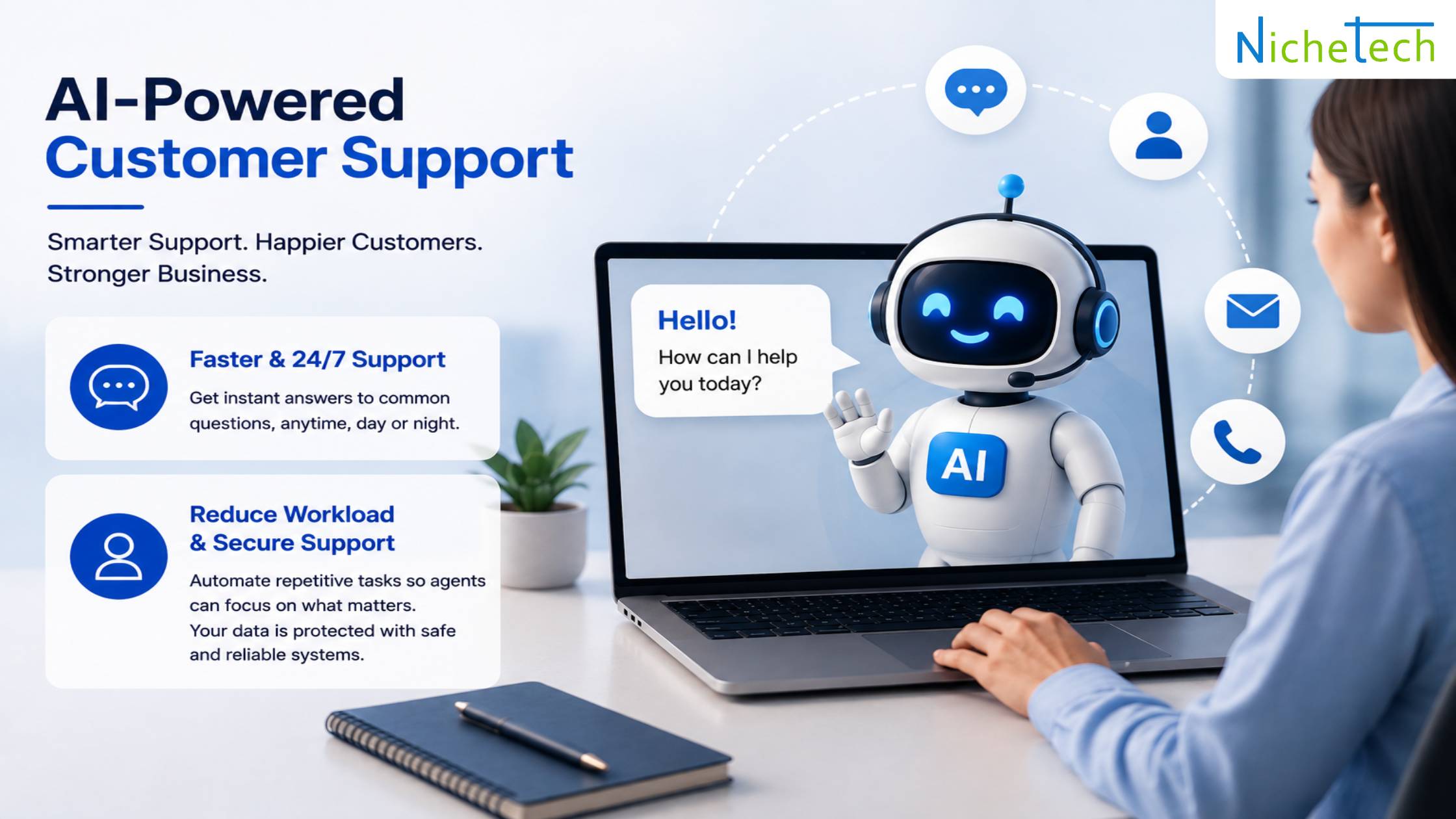
Customer expectations have changed significantly in recent years. People want businesses to respond quickly, provide accurate information and remain available across the channels they already use.
For companies handling hundreds or thousands of customer interactions every day, meeting these expectations through traditional support processes can become increasingly difficult.
This is where AI-powered customer support systems are becoming a practical solution. By combining artificial intelligence with customer service workflows, businesses can automate repetitive interactions, respond to common questions faster and help support teams manage higher volumes of requests.
However, successful implementation requires more than simply adding an AI chatbot to a website. Businesses need to consider accuracy, security, integration, user experience and the role of human support.
What Are AI-Powered Customer Support Systems?
AI-powered customer support systems use technologies such as natural language processing, machine learning, conversational AI and automation to understand customer requests and provide relevant responses.
These systems can be deployed through websites, mobile applications, messaging platforms and other digital channels. Depending on the business requirements, they can answer frequently asked questions, guide users through processes, collect information, assist with troubleshooting and transfer complex conversations to human representatives.
The real value comes from designing the technology around the company’s customer journey rather than treating AI as a standalone feature.
Why Businesses Are Adopting AI for Customer Support
Customer support teams often spend a significant amount of time answering repetitive questions. Customers may frequently ask about order status, account information, appointments, product features, pricing, availability or basic troubleshooting.
Although these questions may be straightforward, answering each one manually consumes employee time. As customer volume increases, businesses may need additional support staff simply to maintain acceptable response times.
AI can handle many routine interactions automatically, allowing human agents to concentrate on complex issues that require judgement and personal attention. This can improve efficiency without compromising the importance of human support.
Faster Responses Can Improve Customer Experience
Customers don’t always want to wait several hours for an answer to a simple question. Delayed responses can create frustration, particularly when the information they need is readily available.
An intelligent support assistant can provide immediate responses to common requests. This can help businesses reduce waiting times and provide a more convenient experience for customers.
For companies operating across different time zones, automated assistance can also ensure that customers have access to basic support outside traditional business hours.
24/7 Support Without Expanding the Entire Team
Maintaining a round-the-clock human support operation can require significant resources. Businesses may need additional employees, multiple shifts and greater operational overhead.
AI can provide automated assistance at any time of day. Customers can ask questions during evenings, weekends or holidays and receive immediate responses for supported requests.
However, 24/7 availability doesn’t mean every interaction should remain automated. A well-designed system should recognise when a customer needs human assistance and provide a smooth transition to an appropriate support representative.
Reduce Repetitive Work for Support Agents
Repetitive questions can take up a considerable portion of a support team’s working day. When agents repeatedly answer the same basic questions, they have less time available for complex customer problems.
An AI assistant can take care of many routine conversations and provide basic information before involving a human agent. This allows support employees to focus on cases that require investigation, empathy, negotiation or technical expertise.
The result can be a more productive support operation where people spend their time on work that genuinely requires human involvement.
Personalised Support Through Intelligent Systems
Modern AI can go beyond simple question-and-answer interactions. When connected to authorised business data, an intelligent system can provide responses based on a customer’s specific context.
For example, an ecommerce application could assist with order-related questions, while a service business could help customers check appointments or service requests. A SaaS platform could guide users through product features or troubleshooting steps.
Personalisation should always be balanced with privacy and security. AI should only access the information required for its intended purpose and should operate within clearly defined permissions.
Support Across Websites and Mobile Applications
Customers interact with businesses through multiple digital touchpoints. They may visit a website, use a mobile application, send a message or contact a support team through another platform.
AI-powered support can be integrated into these experiences so customers can receive assistance where they are already interacting with the business. This creates a more consistent support journey and reduces the need to manage completely separate processes for every channel.
For businesses developing new digital products, AI capabilities can also be incorporated directly into the application experience rather than being added later as a separate tool.
Better Customer Support Analytics
Every customer interaction contains useful information. Businesses can analyse common questions, frequently reported problems, response times, customer sentiment and support trends to understand where improvements may be needed.
For example, if customers repeatedly ask about the same product feature, the issue may not simply be a support problem. It could indicate that the product interface, documentation or onboarding process needs improvement.
AI-supported analytics can therefore help businesses use customer conversations as a source of insight for improving products and services.
The Challenge of AI Accuracy
AI systems can be highly capable, but they are not infallible. They may misunderstand customer intent, lack sufficient context or provide an incorrect response.
This becomes especially important when dealing with technical, financial, legal or other sensitive information. A response that sounds confident but is inaccurate can damage customer trust.
Businesses should therefore define clear boundaries for AI systems. Responses should be tested, monitored and regularly improved, while complex or sensitive situations should have an appropriate path to human support.
Human Support Still Matters
One of the biggest mistakes businesses can make is treating AI as a complete replacement for customer service employees.
Customers may still want to speak with a person when dealing with complaints, unusual problems, sensitive situations or issues that require negotiation and judgement. Human empathy remains difficult to replicate through automation.
The strongest approach is often a combination of AI and human expertise. AI handles routine interactions and gathers relevant information, while human representatives take over when their experience and understanding are needed.
Data Security and Privacy Cannot Be Ignored
Customer support systems may process names, contact details, account information, purchase history, service records and other sensitive data. Introducing AI into these workflows makes data security an important part of the development process.
Businesses should carefully evaluate how customer information is collected, stored, processed and accessed. Authentication, authorisation, encryption, secure APIs and appropriate data-handling policies should be considered when designing the system.
Security should not be added after development is complete. It should be considered from the architecture and integration stages onward.
Integration With Existing Business Systems
An AI support solution becomes significantly more useful when it can communicate with the systems a business already uses.
Depending on the organisation, this could include CRM platforms, ecommerce systems, ticketing software, databases, payment systems or internal business applications.
Proper integration allows the AI system to work with relevant business information rather than providing only generic responses. APIs and secure integrations can help connect these systems while maintaining appropriate access controls.
This is particularly important for businesses that need a solution designed around their existing workflows rather than a generic chatbot.
Custom AI Development Can Solve Specific Business Problems
Every business has different support processes and customer expectations. A basic chatbot may be enough for a company that only needs to answer frequently asked questions, while another organisation may require a more sophisticated system capable of understanding customer context and connecting with multiple backend systems.
Custom AI development can provide greater flexibility in these situations. Businesses can create solutions around their specific workflows, data sources, integrations and customer interactions rather than changing their processes to fit a pre-built product.
This approach can be particularly valuable when AI needs to become part of a larger web or mobile application.
Implementation Requires More Than Choosing an AI Model
Successful AI customer support requires careful planning. Businesses need to determine which interactions should be automated, what information the system needs, how conversations should be handled and when customers should be transferred to human agents.
The knowledge base also needs to be accurate and regularly updated. Testing is equally important because the system needs to perform reliably across different customer questions, writing styles and real-world scenarios.
A well-planned implementation focuses on the complete customer journey rather than simply measuring how many conversations AI can handle.
Measuring the Impact of AI Support
Businesses should define clear goals before implementing an AI support system. These may include reducing response times, improving customer satisfaction, increasing first-contact resolution, reducing repetitive workloads or improving support team productivity.
Monitoring these metrics helps businesses understand whether the technology is actually solving the intended problem.
AI systems should also be continuously improved based on real customer interactions. As products, services, and customer expectations change, the support system needs to evolve with them.
Where AI-Powered Customer Support Is Heading
Customer support is likely to become increasingly intelligent and connected with other business systems. AI assistants may move beyond answering questions and begin helping customers complete tasks, guiding employees through support processes, identifying potential issues and providing recommendations based on customer context.
However, successful adoption will not simply be about automating as many conversations as possible. Businesses will need to determine where automation creates genuine value and where human interaction remains essential.
The future of customer support is likely to be a combination of intelligent technology and human expertise working together.
Choosing the Right Development Partner
Businesses considering an AI customer support solution should look beyond basic chatbot functionality. The development partner should understand AI technologies as well as web and mobile application development, API integration, data management, security and ongoing maintenance.
A capable technology partner can help identify suitable AI use cases, design the customer journey, integrate the solution with existing systems and provide support after deployment. This is particularly important for businesses planning a custom solution rather than adopting a simple plug-and-play chatbot.
Final Thoughts
AI-powered customer support systems can help businesses provide faster responses, automate repetitive interactions, improve support efficiency and deliver assistance beyond traditional working hours. When implemented correctly, they can also provide valuable insights into customer behaviour and recurring service issues.
At the same time, businesses need to address challenges involving accuracy, security, API integration and human oversight. AI should not be viewed simply as a replacement for support teams.
The most effective solutions use AI where automation makes sense while keeping human experts involved when customers need empathy, judgement or specialised assistance. For businesses planning to modernise customer support, a carefully designed AI solution can become an important part of a broader digital transformation strategy.
FAQs
1. What is an AI-powered customer support system?
It is a software solution that uses artificial intelligence to understand customer requests and assist with questions, troubleshooting and other support activities.
2. Can AI completely replace customer support agents?
AI can automate many routine interactions, but human agents remain important for complex, sensitive and personalised customer situations.
3. What are the main benefits of AI customer support?
Key benefits include faster responses, 24/7 availability, reduced repetitive work, improved scalability, personalised interactions and useful customer support analytics.
4. What challenges should businesses consider?
Businesses should consider AI accuracy, data security, privacy, integration with existing systems, implementation costs and human escalation.
5. Can AI support be integrated into a mobile application?
Yes. AI capabilities can be integrated into mobile and web applications to provide conversational assistance, personalised experiences and automated workflows.
6. When should a business consider custom AI development?
Custom development can be useful when a business needs specialised workflows, unique customer interactions, integration with existing applications or greater control over how AI processes business information.