
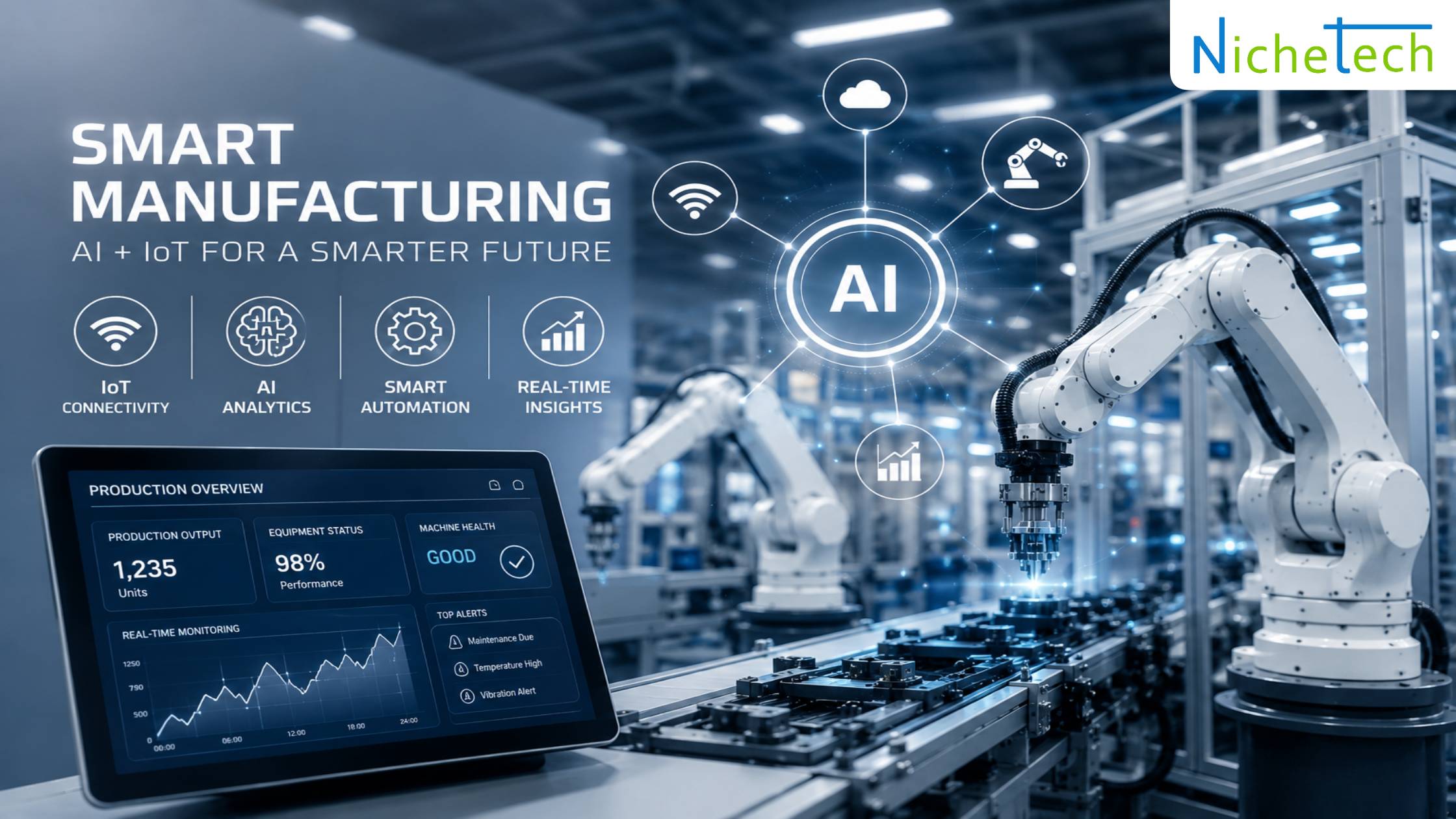
India’s manufacturing sector is undergoing a significant transformation. As businesses face increasing pressure to improve productivity, reduce operational costs, maintain quality standards and compete in global markets, traditional manufacturing processes are no longer enough.
Today, technologies such as Artificial Intelligence (AI) and the Internet of Things (IoT) are helping manufacturers create smarter, more connected and highly efficient operations. This shift toward smart manufacturing is changing how factories operate, enabling businesses to make better decisions, improve production efficiency and respond more quickly to market demands.
From real-time equipment monitoring to predictive maintenance and automated workflows, AI and IoT are becoming essential tools for modern manufacturing organizations across India.
What Is Smart Manufacturing?
Smart manufacturing combines advanced technologies such as AI, IoT, automation, cloud computing and data analytics to optimize manufacturing operations.
Connected devices and sensors collect data from machines, production lines, assets, and operational processes. This data is then analyzed to generate actionable insights that help businesses improve performance.
Rather than simply collecting information, smart manufacturing enables businesses to understand what is happening across the factory floor in real time and respond proactively.
This creates a more agile, efficient and intelligent manufacturing environment.
The Growing Importance of AI in Manufacturing
Artificial Intelligence is becoming a powerful driver of manufacturing innovation.
Manufacturing facilities generate enormous amounts of data every day. AI systems can analyze this data much faster than humans, helping businesses identify patterns, predict outcomes and optimize operations.
AI can help manufacturers improve production planning, forecast demand, detect quality issues and automate repetitive tasks.
Instead of reacting to problems after they occur, businesses can use AI to anticipate potential challenges and take preventive action before disruptions impact production.
This proactive approach improves efficiency while reducing operational risks.
How IoT Connects the Factory Floor
The Internet of Things plays a crucial role in smart manufacturing.
IoT devices use sensors and connected systems to collect data from machines, equipment, vehicles and production lines. This information is then transmitted to centralized platforms where it can be analyzed in real time.
For example, sensors can monitor machine temperature, vibration levels, energy consumption and operational performance. Managers gain instant visibility into what is happening across the factory floor without relying on manual reports or inspections.
This connected environment improves operational awareness and enables faster decision-making.
Real-Time Visibility Improves Operational Control
One of the biggest advantages of AI and IoT in manufacturing is real-time visibility.
Traditional manufacturing environments often rely on delayed reporting and manual data collection. By the time issues are identified, valuable production time may already be lost.
Smart manufacturing systems provide immediate access to operational data. Production managers can monitor equipment performance, track workforce activities, review production status and identify bottlenecks as they occur.
This visibility allows businesses to respond quickly and maintain better control over operations.
Predictive Maintenance Reduces Equipment Downtime
Equipment downtime remains one of the most expensive challenges in manufacturing. Unexpected machine failures can disrupt production schedules, delay deliveries and increase maintenance costs.
AI-powered predictive maintenance helps solve this problem.
By analyzing data collected through IoT sensors, AI systems can identify signs of potential equipment failure before breakdowns occur.
Maintenance teams receive alerts when machines require attention, allowing repairs to be scheduled proactively. This reduces downtime, improves equipment reliability and extends asset lifespan.
Better Quality Control Through AI
Maintaining consistent product quality is essential for manufacturing success.
AI-powered quality control systems can analyze production data and detect defects more accurately than traditional inspection methods.
Advanced machine learning algorithms can identify irregularities, monitor production standards and flag potential quality concerns in real time.
This helps manufacturers reduce waste, minimize product recalls and improve customer satisfaction. Higher quality standards also strengthen brand reputation and competitiveness in the market.
Improving Workforce Productivity
Smart manufacturing is not about replacing workers, it is about helping them work more efficiently.
AI and IoT technologies provide employees with better information, improved workflows and enhanced decision-making capabilities.
Workers spend less time on repetitive manual tasks and more time focusing on activities that create value.
Managers can monitor workforce performance, assign tasks more effectively and optimize labor utilization based on real-time data. This creates a more productive and collaborative work environment.
Energy Efficiency and Cost Savings
Energy costs are a major concern for many manufacturing businesses. IoT sensors allow manufacturers to monitor energy usage across equipment, production lines and facilities.
AI systems can analyze consumption patterns and identify opportunities to reduce waste. By optimizing energy usage, manufacturers can lower operating costs while supporting sustainability goals.
These savings can have a significant impact on profitability, particularly for large-scale manufacturing operations.
Supply Chain Optimization
Modern manufacturing depends heavily on efficient supply chain management.
AI and IoT technologies help businesses gain better visibility into inventory levels, supplier performance, logistics operations and production requirements.
Real-time insights allow manufacturers to forecast demand more accurately, optimize inventory management and reduce supply chain disruptions.
Improved coordination across the supply chain helps businesses maintain production continuity and meet customer expectations more effectively.
The Role of Manufacturing Industry Apps
As manufacturing operations become more connected, businesses increasingly rely on digital platforms to manage activities efficiently.
A modern Manufacturing Industry App helps organizations centralize workforce management, maintenance operations, inspections, production tracking and operational reporting.
Combined with AI and IoT technologies, these applications provide managers with complete visibility into field operations and factory activities.
This centralized approach improves communication, accountability and decision-making throughout the organization.
Challenges in Adopting Smart Manufacturing
While the benefits are significant, implementing smart manufacturing requires careful planning.
Manufacturers may face challenges such as technology integration, employee training, infrastructure upgrades and initial investment costs.
However, businesses that successfully adopt AI and IoT often achieve substantial long-term benefits through improved productivity, reduced downtime and enhanced operational efficiency.
The key is developing a clear digital transformation strategy that aligns with business goals.
The Future of Smart Manufacturing in India
India is rapidly emerging as a global manufacturing hub.
Government initiatives, increasing technology adoption and growing investments in digital transformation are accelerating the adoption of smart manufacturing practices across industries.
As AI and IoT technologies continue to evolve, Indian manufacturers will gain even greater opportunities to improve efficiency, enhance competitiveness and drive innovation.
Factories that embrace these technologies today will be better positioned for future growth and long-term success.
Final Thoughts
Smart manufacturing is reshaping the future of Indian industry. By combining Artificial Intelligence, IoT, real-time data and connected systems, manufacturers can improve productivity, reduce costs, minimize downtime and enhance operational visibility.
From predictive maintenance and quality control to workforce management and supply chain optimization, AI and IoT are creating smarter and more efficient manufacturing environments.
A powerful Manufacturing Industry App further strengthens these capabilities by providing centralized control over operations, workforce activities and performance monitoring.
As competition continues to grow, manufacturers that invest in smart technologies will be better prepared to adapt, innovate and succeed in the digital era.
FAQs
1. What is smart manufacturing?
Smart manufacturing uses technologies such as AI, IoT, automation and data analytics to improve production efficiency and operational performance.
2. How does AI help manufacturing companies?
AI helps manufacturers analyze data, predict equipment failures, improve quality control, optimize production planning and automate repetitive tasks.
3. What role does IoT play in manufacturing?
IoT connects machines, equipment and systems through sensors that collect and share real-time operational data.
4. What is predictive maintenance?
Predictive maintenance uses AI and IoT data to identify potential equipment issues before failures occur, reducing downtime and maintenance costs.
5. How can a Manufacturing Industry App support smart manufacturing?
A Manufacturing Industry App helps businesses manage workforce operations, maintenance activities, inspections, reporting and real-time operational visibility from a centralized platform.