
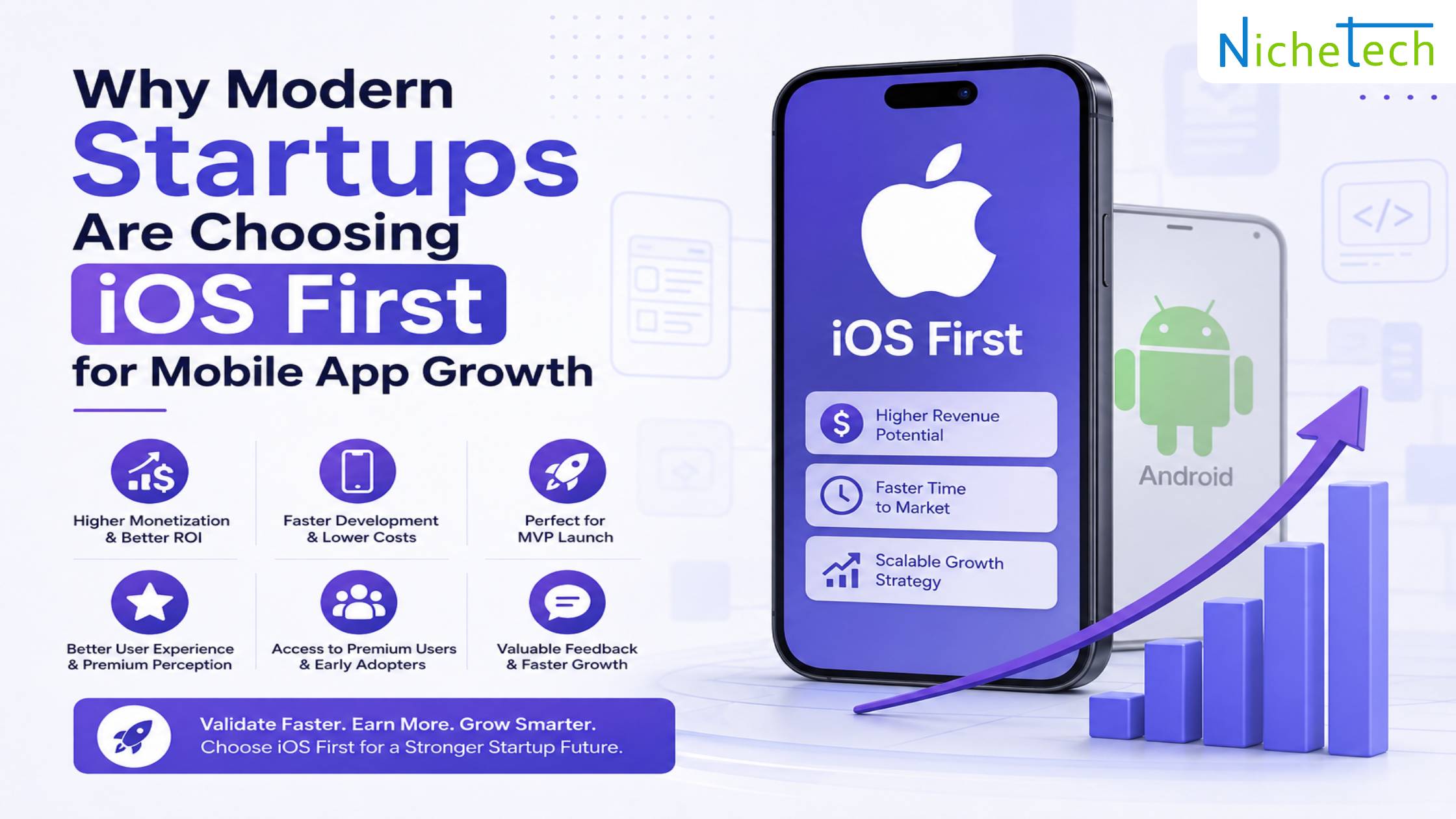
For every startup founder, launching a mobile application begins with one major question: “Should we build for iOS, Android, or both platforms together?”
While launching on both platforms sounds like the ideal strategy, the reality for most startups is very different. Limited budgets, tight deadlines, smaller development teams, and the need for faster market entry often force startups to prioritize one platform first.
Over the last few years, a clear trend has emerged in the startup ecosystem. Many successful startups are now choosing iOS App Development as their first step before expanding to Android later. From fintech startups and SaaS products to AI-powered applications and healthcare platforms, businesses increasingly see Apple’s ecosystem as the ideal environment for launching scalable digital products.
But why are startups prioritizing iOS over Android during the early stages of growth?
Let’s explore the biggest reasons why iOS App Development has become the preferred strategy for modern startup growth.
1. Higher Monetization and Better ROI
It is a well-documented fact in the mobile industry that while Android captures a larger market share globally, iOS App Development users spend significantly more on apps. According to global app revenue data, the Apple App Store consistently outperforms Google Play in terms of consumer spend on in-app purchases, premium subscriptions and paid downloads.
This difference becomes extremely important for startups whose business models rely heavily on monetization. Whether the app offers premium subscriptions, exclusive content, SaaS tools or digital services, iOS users are generally more willing to pay for high-quality applications and experiences.
For startups, generating revenue early is critical. Investors and founders want proof that users are willing to spend money on the product before scaling operations further. Launching on iOS first allows businesses to validate their monetization strategy faster and gather important financial insights early in the growth journey.
2. Faster Development and Lower Costs
Many entrepreneurs assume that iOS app development is more expensive, but from a practical development perspective, the opposite is often true.
One of the biggest challenges with Android development is device fragmentation. Android operates across thousands of smartphones with different screen sizes, processors, operating system versions and hardware capabilities. Testing an application across all these devices requires significant time, effort and development resources. On the other hand, Apple maintains a highly controlled ecosystem.
The iOS Advantage:
Fewer Devices: Developers only need to optimize the app for a limited number of iPhones and iPads.
Faster Software Adoption: Apple users quickly adopt the latest iOS updates.
Simplified Testing: Fewer compatibility issues reduce testing complexity.
Better Performance Optimization: Developers can focus more on quality and user experience instead of device-specific troubleshooting.
Because there are fewer devices to test and maintain, startups can significantly reduce development time and launch their Minimum Viable Product (MVP) much faster.
The Takeaway for Startups:
An iOS-first strategy helps startups reduce development costs, speed up product launches and minimize technical complications during the early stages of growth.
3. The Perfect Environment for Building an MVP
For every startup, the early stage is all about experimentation, validation and learning what users actually want. Instead of investing heavily in a full-featured product from day one, most startups begin with an MVP. An MVP helps businesses launch faster, gather real-world feedback and improve the product based on actual user behavior.
This is where iOS becomes a strong advantage for startups. Since Apple has a controlled ecosystem with fewer devices and standardized software versions, developers can build, test and launch MVPs much more efficiently compared to Android. Faster development means startups can enter the market quickly and start collecting valuable customer insights without wasting time on excessive compatibility testing.
Another major benefit is the ability to release updates smoothly. Startups often need to improve features, fix bugs, and respond to user feedback rapidly during the MVP stage. iOS makes this process easier because a large percentage of Apple users adopt the latest iOS versions quickly, allowing startups to maintain consistency across their user base.
The Takeaway for Startups:
Launching an MVP on iOS helps startups validate their ideas faster, reduce unnecessary development costs and make data-driven product decisions before expanding to Android or scaling further.
4. Better User Experience and Premium Brand Perception
Apple products are globally recognized for delivering premium digital experiences. iOS users typically expect applications to be smooth, visually polished, secure and easy to use.
Apple’s strict design standards and Human Interface Guidelines encourage developers to create apps with better navigation, cleaner interfaces and consistent user experiences.
For startups, this can be a huge branding advantage.
A professionally designed mobile app creates stronger first impressions, increases customer trust, and improves user retention rates. Since early users often judge a startup’s credibility based on app quality, launching a polished iOS application can positively impact overall brand perception.
In competitive industries such as fintech, healthtech, AI and SaaS, user experience can directly influence customer acquisition and long-term growth.
The Takeaway for Startups:
Launching on iOS first helps startups deliver a premium user experience that strengthens brand credibility and improves customer engagement.
5. Early Access to Premium Users and Tech Innovators
Demographically, iOS users are often characterized as early adopters who are eager to try new technologies, provide constructive feedback, and advocate for brands they love. If your startup is introducing a disruptive or innovative solution (especially in Fintech, Healthtech, or AI-driven apps), the iOS user base provides the ideal demographic to test and refine your value proposition.
Summary: Is iOS First Right for Your Startup?
While the iOS-first strategy is incredibly effective, it ultimately depends on your target audience. If your primary market is a region heavily dominated by Android or if your app targets a demographic that exclusively uses budget smartphones, Android might be your starting point.
However, if your goal is fast validation, higher revenue potential, lower initial development hassle and attracting premium users, going iOS-first is a proven strategy for sustainable startup growth.
6. Early Access to Premium Users and Tech Innovators
Demographically, iOS users are often considered early adopters who enjoy trying innovative technologies and premium digital products. These users are more likely to:
Test new applications
Provide constructive feedback
Spend on premium features
Recommend products to others
Become loyal brand advocates
If your startup is introducing disruptive solutions such as AI-powered tools, fintech services, productivity platforms or smart automation apps, the iOS audience becomes an ideal testing environment.
Positive feedback from early adopters can also improve App Store visibility and drive organic growth through reviews and recommendations.
The Takeaway for Startups:
iOS users often help startups gain faster traction, valuable product feedback and stronger early-stage brand awareness.
Frequently Asked Questions
Q1: Is it more expensive to hire iOS developers compared to Android developers?
Answer: While hourly rates for premium iOS developers can sometimes be slightly higher, the overall project cost for an iOS MVP is often lower because the development and testing cycle is shorter due to less device fragmentation.
Q2: Can we migrate our iOS app to Android later?
Answer: Absolutely. Once your iOS app validates your business model and gathers user feedback, you can use those insights to build a highly optimized Android app, or transition to a cross-platform framework like Flutter or React Native.
Q3: How long does it typically take to launch a startup MVP on iOS?
Answer: Depending on the complexity of features, a standard, robust iOS MVP can take anywhere from 8 to 12 weeks to develop, test and deploy to the App Store.
Q4: Which industries benefit the most from iOS App Development?
Answer: Industries such as fintech, healthcare, SaaS, AI-powered applications and premium subscription platforms often benefit significantly from launching on iOS first.
Q5: Can startups use cross-platform frameworks after launching on iOS?
Answer: Yes. After validating the MVP through iOS App Development, startups can later expand using frameworks like Flutter or React Native for faster multi-platform scaling.
Let’s Build Your Growth Engine Together
Choosing the right tech stack and platform architecture can make or break your startup. At Nichetech Solutions, we specialize in crafting custom, scalable and secure Mobile Applications tailored to your business goals. Whether you need an elite team to build your iOS MVP or a comprehensive cross-platform strategy, our experts are here to guide you.
👉 Contact Nichetech Solutions today to discuss your project with our technology consultants.